September 17, 2025 – Dr. Susanna Kokkonen
Is there a price too high to pay for words?
This is a question countless people have asked throughout history. Because the truth is that at times of crisis or in a dictatorship it is often mere words that get a person in deep trouble. So one might not be part of resistance as in fighting by arms or doing something against the regime, but one might be speaking of things that “should not be said.”
What is forbidden varies based on cultural context and time. One of the stories that recent days have reminded me of is from Nazi Germany. The story is very moving because it concerns young people. They paid with their lives for the change they wanted to bring on.
The Birth of White Rose
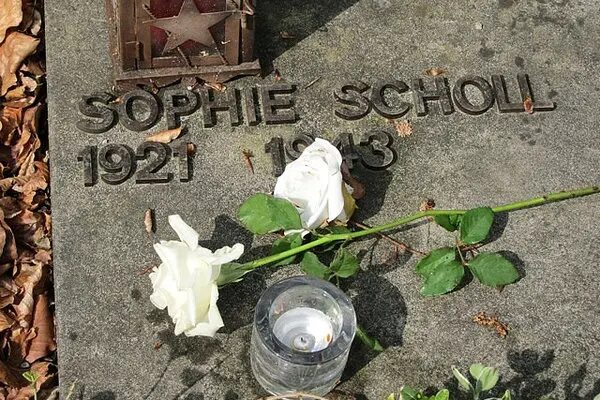
This is the story of Sophie (1921-1943) and Hans (1918-1943) Scholl and their little group in the city of Munich in Southern Germany. They called their group by a beautiful name Weiße Rose, White Rose in English.
But earlier, the youth were enthusiastic about Adolf Hitler when he came to power in 1933. They were too young, too naïve, and too taken by general enthusiasm to question anything. In fact we know that Sophie’s and Hans’ father was more cautious and tried to hint at something problematic with the Nazi Party. The youth did not get it.
What we need to remember is that the Nazis systematically educated youth of Germany in Nazi ideals and with Nazi propaganda. There was an effort to separate them from influences that were considered old-fashioned, such as the church or their family. Hitler Youth and other similar organizations became their home and educated the young.
A change happened in the Scholl family when Hans served in the army and saw what was happening in the Eastern Front. We do know that he saw what the SS did to the Jews. We could assume that he saw a lot of violence, death, and persecution. Something changed and caused him and his friends to question everything. Along with his friends and fellow medical students Willi Graff (1918-1943) and Alexander Schmorell (1917-1943) he wanted to resist.
Spreading Words
The Scholl siblings as well as their friends started getting leaflets printed, spread them at the university of Munich as well as outside the university in public places. They also painted the messages on walls. Not only were they against the anti-Jewish policies of the Nazi regime, but they also resisted the war. But all they were using were words.
At the university, an important professor of philosophy Kurt Huber (1893-1943) was also resisting the Nazis, and later they executed him. White Rose even staged a public demonstration. The Gestapo (political police) was closely following and trying to find them. What they were doing was extremely risky. Naturally, Gestapo caught them. But it is important to know that they were denounced.
The Price
In February 1943, Sophie and Hans and three other group members were arrested. They were interrogated and tried. Sophie, Hans and Cristoph Probst were executed by guillotine on February 22, 1943. (Willi Graff was beheaded in October of the same year. Alexander Morell’s family appealed, and he was executed in July once Hitler had personally rejected the family’s appeal.)
I remember watching the movie “Sophie Scholl, Die Letzten Tage” (Last days) together with my mother one summer at night. I remember our shock – how we could not sleep after watching the film. The movie was based entirely on real Gestapo interrogation files. In its simplicity it was extremely powerful. One of the last scenes of this movie was when the Scholl parents came to see their kids.
How might they have felt knowing that in a few hours their precious children would be facing the guillotine?
The last words Sophie’s mother spoke to her daughter were: “Think about Jesus.”
The Question
These last days, I have been thinking about this story. Maybe you want to think about this too.
Is there a price too high to pay for words?
The Holocaust Remembrance Association exists to remember, reconcile, and take a stand against antisemitism in all its forms.