March 6, 2026 – Dr. Susanna Kokkonen
Va Yak’hel-Pekudei 5786 (2026)
Exodus 35:1-40:38; Ezekiel 45:18-46:15
Va Yak’hel-Pekudei, the two Hebrew words in this Torah portion refer to gathering and amounts of. These are the last two Torah portions of the Book of Exodus. Here people gathered as a group and a community. The portion details the contributions, the materials, for the building of the mishkan (that is the Tabernacle).
Sabbath
The first and, as we know, an exceedingly important commandment that set apart the Jewish people was Sabbath.
“For six days, work is to be done, but the seventh day shall be your holy day, a day of sabbath rest to the LORD.” (Exodus 35:2 NIV)
Once Sabbath had been commanded, the request to give was made. It included all that was needed for the building of the Tabernacle.
“From what you have, take an offering for the LORD. Everyone who is willing is to bring to the LORD an offering of gold, silver and bronze; blue, purple and scarlet yarn and fine linen; goat hair; ram skins dyed red and another type of durable leather ; acacia wood; olive oil for the light; spices for the anointing oil and for the fragrant incense; and onyx stones and other gems to be mounted on the ephod and breast piece.
Skilled Workers
Even work, as a form of offering, is mentioned in our text.
“All who are skilled among you are to come and make everything the LORD has commanded…” (Exodus 35:5-10 NIV)
Moses asked various skilled people to help with specific aspects of the work. From this we understand that God has given people unique abilities to serve in different areas of service. It means that apart from our daily work, we are to use our gifts to serve God.
“…the LORD has chosen Bezalel son of Uri, the son of Hur, of the tribe of Judah, and he has filled him with the Spirit of God, with wisdom, with understanding, with knowledge and with all kinds of skills… (Exodus 35:30-31 NIV)
“And he has given both him and Oholiab son of Ahisamak, of the tribe of Dan, the ability to teach others.” (Exodus 35:34 NIV)
The Glory
The most important reason for the building work was to build a place for God’s presence. Set apart from other nations, the Presence of God was with the Jewish people. The glory of God was amid them, and this glory was tangible, thick, and filled the Tabernacle.
“Then the cloud covered the tent of meeting, and the glory of the LORD filled the tabernacle. Moses could not enter the tent of meeting because the cloud had settled on it, and the glory of the LORD filled the tabernacle.” (Exodus 40:34-35 NIV)
Ezekiel’s Temple
The prophetic portion from Ezekiel highlights a remarkably interesting aspect of making atonements. Here atonement was made for the temple itself. The Temple of course was a place where people brought themselves and their burdens. People and the temple are connected in a unique way.
“The priest is to take some of the blood of the sin offering and put it on the doorposts of the temple, on the four corners of the upper ledge of the altar and on the gateposts of the inner court. You are to do the same on the seventh day of the month for anyone who sins unintentionally or through ignorance; so you are to make atonement for the temple.” (Ezekiel 45: 19-20 NIV)
This reminds us of Jesus. Jesus was at home at the temple.
First, Jesus was taken to the temple as a baby to be circumcised.
“When the time came for the purification rites required by the Law of Moses, Joseph and Mary took him to Jerusalem to present him to the Lord” (Luke 2:22 NIV)
Later, he chose to remain there when Passover (Pesach) Festival was over. His parents were looking for him and came back.
“After three days they found him in the temple courts, sitting among the teachers, listening to them and asking them questions.” (Luke 2:46 NIV)
Holocaust Garden of Hope
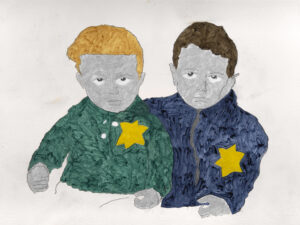
Throughout these Torah portions you are invited to connect the Torah with the New Testament and then to see how connections exist between the Bible and the Holocaust and our stories. Our stories are stories of people who perished, who fought, who survived and some who were evil. We tell the story of the Holocaust, but our focus is on children and youth.
Skilled workers, artists, and writers have prepared the exhibits. Just like the Tabernacle was a team effort of people having skills in various areas, the Holocaust Garden of Hope is a place many individuals worked on. The Graden was lovingly made possible by “offerings,” donors, who donated their time and their funds.
You are reading this text for a reason. May this be your invitation to join us and be part of something unique!
*For an explanation of the terms see the first The Torah Portion Blog.
And God said, “Let there be light,” and there was light.
Genesis 1:3 NIV
Your word is a lamp for my feet, a light on my path.
Psalm 119:105 NIV
Arise, shine, for your light has come, and the glory of the LORD rises upon you.
Isaiah 60:1 NIV
…let your light shine before others, that they may see your good deeds and glorify your Father in heaven.
Matthew 5:16 NIV
Torah Scrolls were attacked and desecrated during the Holocaust. The enduring images of the Kristallnacht (November 9-10,1938) are those of synagogues on fire and Torah Scrolls burning. Some of these desecrated Torah Scrolls disappeared, others were buried. Some were lovingly rescued and are on display in museums in various locations.
[author] [author_image timthumb=’on’]https://irw.duv.temporary.site/website_047320a9/wp-content/uploads/2025/09/dr-k.jpg[/author_image] [author_info]Dr. Susanna Kokkonen received her Ph.D. in Holocaust Studies from the Hebrew University of Jerusalem. For ten years Dr. Kokkonen was the Director of the Christian Friends of Yad Vashem, World Holocaust Remembrance Center in Jerusalem. Dr. Kokkonen has authored several books about the Holocaust and antisemitism. She educates Christian audiences worldwide including about the Jewish roots of their faith. Dr. Kokkonen is the author of the exhibits for the Holocaust Garden of Hope and serves the Holocaust Remembrance Association as Educational Advisor. [/author_info] [/author]