
Devarim 5785 (2025)
Deuteronomy 1:1-3:22 (Haftarah: Isaiah 1:1-27)
Devarim, the name of this Torah portion means “words” or “things.” It is also the name of the Book of Deuteronomy in Hebrew. The portion contains journeys, appointments of leaders and judges, orders to attack versus not to attack. We learn about encounters with various nations. God appointed Joshua to his task. Moses spoke, as God gave words to him.
Time to move
When God said to the nation that they had stayed long enough in a place, this was highly significant. One of the fundamental concepts of the Bible is that God controls the timing of various events. As we know there are “certain times for certain things” to take place. This is true whether in the lives of Israel or individual people. When God says it is the time for something, then it is important to start moving. If God has given anyone a certain task to perform, just like in the journeys of the Israelites, the person still must take the step and trust God.
“The Lord our God said to us at Horeb, “You have stayed long enough at this mountain. Break camp and advance into the hill country of the Amorites; go to all the neighboring peoples in the Arabah, in the mountains, in the western foothills, in the Negev and along the coast, to the land of the Canaanites and to Lebanon, as far as the great river, the Euphrates. See, I have given you this land. Go in and take possession of the land the Lord swore he would give to your fathers—to Abraham, Isaac, and Jacob—and to their descendants after them.” (Deuteronomy 1:6-8 NIV)

Spies’ Report
The reading of this Torah portion coincides with a specific date in the Hebrew calendar. This is Tisha be Av, a date when all kinds of calamities took place.
But it all began as Moses sent spies out to investigate the Land of Canaan. This was the Promised Land – promised to the Israelites. Indeed the spies saw that it was an incredibly good and rich land. But they brought back a bad report. They discouraged the people, as they were fearful of their inhabitants. This event took place on Tisha be Av.
“But you were unwilling to go up; you rebelled against the command of the Lord your God. You grumbled in your tents and said, “The Lord hates us; so he brought us out of Egypt to deliver us into the hands of the Amorites to destroy us. Where can we go? Our brothers have made our hearts melt in fear. They say, ‘The people are stronger and taller than we are; the cities are large, with walls up to the sky.” We even saw the Anakites there.” “Then I said to you, “Do not be terrified; do not be afraid of them.” (Deuteronomy 1:26-29 NIV)
On this portion there are only two people who kept their place in future Jewish history. Two men would also inherit the promised land because their courage did not fail. It was not just the courage they had. They knew that God had given them that land. So this whole chain of events was not about human courage -which we might or might not have- but about trust in God’s ability to perform what He has promised.
“…except Caleb son of Jephunneh. He will see it, and I will give him and his descendants the land he set his feet on, because he followed the Lord wholeheartedly.” “Because of you the Lord became angry with me also and said, “You shall not enter it, either. But your assistant, Joshua son of Nun, will enter it. Encourage him because he will lead Israel to inherit it.” (Deuteronomy 1:36-39 NIV)
Encountering Nations
Because of this episode their journey continued in the desert until this generation had completely passed away. So what we want to look at is what happened when they encountered different nations. This is a very current theme because a lot of people seem to think that God was unfair. In their view He gave the Israelites land other nations needed.
It is in this very Torah portion that we see how this is not true. On their way they first encountered the territory of Esau in Seir. God gave them very precise instructions.
“Give the people these orders: ‘You are about to pass through the territory of your relatives the descendants of Esau, who live in Seir. They will be afraid of you, but be very careful. Do not provoke them to war, for I will not give you any of their land, not even enough to put your foot on. I have given Esau the hill country of Seir as his own.” (Deuteronomy 2:4-5 NIV)
They also passed through the land of the Ammonites and here too the same thing happened.
“When you come to the Ammonites, do not harass them or provoke them to war, for I will not give you possession of any land belonging to the Ammonites. I have given it as a possession to the descendants of Lot.” (Deuteronomy 2:19 NIV)
So what do we clearly see here?
The land that was not allocated to Israel, God told them not to take or attack. But when it comes to the land that God wanted them to have, He told them to take possession of it.
“I commanded you at that time: “The Lord your God has given you this land to take possession of it. But all your able-bodied men, armed for battle, must cross over ahead of the other Israelites.” (Deuteronomy 3:18 NIV)
Desolation
The Haftarah portion is from Prophet Isaiah and talks about losing the land. There were terrible injustices taking place in Zion. Because of these, it was to become desolate.
But the worst sin according to the prophet was against the Holy One Himself.
“They have forsaken the Lord;
they have spurned the Holy One of Israel
and turned their backs on him.” (Isaiah 1:4 NIV)
The consequences were not just spiritual but very practical. The destruction and desolation were so total that unless God had extended mercy leaving some survivors, the place would have been destroyed. There would have been no memory of it anymore.
“Your country is desolate,
your cities burned with fire;
your fields are being stripped by foreigners
right before you,
laid waste as when overthrown by strangers.
Daughter Zion is left
like a shelter in a vineyard,
like a hut in a cucumber field,
like a city under siege.
Unless the Lord Almighty
had left us some survivors,
we would have become like Sodom,
we would have been like Gomorrah.” (Isaiah 1:7-9 NIV)
Settling the matter
Even amid destruction and anger God still offered a way out. This is always the case, throughout Jewish history. Even if they forgot God, He never forgot them. In His grace and mercy -even with us individuals- He is always willing to accept us if we repent and we want to come back.
“Come now, let us settle the matter,”
says the Lord.
“Though your sins are like scarlet,
they shall be as white as snow;
though they are red as crimson,
they shall be like wool.” (Isaiah 1:18 NIV)
Jewish History
This Torah portion, as we know, falls on Tisha be Av on which many catastrophes took place. The spies brought back a bad report; Gentiles destroyed the First and Second Temples; outside the Biblical period, the expulsion from Spain in 1492 took place on this date. Religious Jews do not travel during the period leading up to it. It is said that Christopher Columbus was secretly a Jew. He waited just over this date to sail and went on to America.
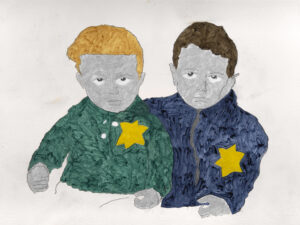
This is a date that religious Jews mark as a date of destruction or catastrophe. Whereas there is the Holocaust Memorial Day, this is a very fitting day (of fast) to be thinking about what happened during the Holocaust. If you choose to fast and pray on this date, today is a time of urgency. Prayer is much needed.
Destruction of the Second Temple
Jesus spoke to his disciples about the Destruction of the Second Temple. This seemed unthinkable, they could not imagine it, but it happened only forty years later. The Destruction of the Second Temple happened on Tisha be Av.
Jesus’s words also had hope in them. He saw an exile. He saw Jerusalem trampled upon by the Gentiles. But He saw that there was set time. The rightful owners would come back.
“They will fall by the sword and will be taken as prisoners to all the nations. Jerusalem will be trampled on by the Gentiles until the times of the Gentiles are fulfilled.” (Luke 21:24 NIV)
On this date, let us fast and pray for Israel and Jerusalem!
*For an explanation of the terms see the first Pearls of The Torah Portion Blog.
| Coral and crystal cannot be mentioned, and the striving for wisdom [is more precious] than pearls. | רָאמ֣וֹת וְ֖גָבִישׁ לֹ֣א יִזָּכֵ֑ר וּמֶ֥שֶׁךְ חָ֜כְמָ֗ה מִפְּנִינִֽים: |
Job 28:18 (NKJV)
Again, the kingdom of heaven is like a merchant seeking beautiful pearls, who, when he had found one pearl of great price, went and sold all that he had and bought it.
Matthew 13:45-46 (NKJV)
Torah Scrolls were attacked and desecrated during the Holocaust. The enduring images of the Kristallnacht (November 9-10,1938) are those of synagogues on fire and Torah Scrolls burning. Some of these desecrated Torah Scrolls disappeared, others were buried. Some were lovingly rescued and are on display in museums in various locations.
[author] [author_image timthumb=’on’]https://irw.duv.temporary.site/website_047320a9/wp-content/uploads/2023/12/Dr-Sussanna-K-Round.png[/author_image] [author_info]Dr. Susanna Kokkonen received her Ph.D. in Holocaust Studies from the Hebrew University of Jerusalem. For ten years Dr. Kokkonen was the Director of the Christian Friends of Yad Vashem, World Holocaust Remembrance Center in Jerusalem. Dr. Kokkonen has authored several books about the Holocaust and antisemitism. She educates Christian audiences worldwide including about the Jewish roots of their faith. Dr. Kokkonen is the author of the exhibits for the Holocaust Garden of Hope and serves the Holocaust Remembrance Association as Educational Advisor. [/author_info] [/author]