
Matot-Masei 5785 (2025)
Numbers 30:2-36:13 (Haftarah: Jeremiah 2:4-28, 4:1-2, Isaiah 66:1, 23-24)
Matot-Masei, the name of this double Torah portion means Tribes and Journeys. It starts with vows a man or a woman makes to God and must fulfill unless there is a specific stipulation relating to circumstances, such as in the case of a woman, a husband annulling her vow. The portion then moves on to discuss just what happened (see the previous Torah portions) with the Prince of Moab, the diviner Balaam, and the fall of the Israelites into idolatry.
There was going to be a war, and it was the Lord’s.
“So Moses said to the people, “Arm some of your men to go to war against the Midianites so that they may carry out the Lord’s vengeance on them.” (Numbers 31:2 NIV)
The Diviner had failed to put a curse on Israel. He had nevertheless given the Midianites advice on how to defeat the Israelites. They found him.
…”They also killed Balaam son of Beor with the sword.” (Numbers 31:8 NIV)
Two tribes, Reubenites and Gadites wanted to settle in a very desirable land on the other side of the Jordan river. Moses mistook this for not wanting to fight with the other tribes for the land. He became angry.
“Moses said to the Gadites and Reubenites, “Should your fellow Israelites go to war while you sit here? Why do you discourage the Israelites from crossing over into the land the Lord has given them?” (Numbers 32: 6-7 NIV)
The two tribes confirmed that this was not their intent. They were first going to come and fight with the others, then settle into the land they desired.
“But we will arm ourselves for battle and go ahead of the Israelites until we have brought them to their place. Meanwhile our women and children will live in fortified cities, for protection from the inhabitants of the land. We will not return to our homes until each of the Israelites has received their inheritance.“ (Numbers 32: 17-18 NIV)
The second part of the Torah portion deals with the journeys of the Israelites in the desert.
“Here are the stages in the journey of the Israelites when they came out of Egypt by divisions under the leadership of Moses and Aaron. At the Lord’s command Moses recorded the stages in their journey.” (Numbers 33: 1-2 NIV)
Again, the emphasis of the instructions was that they were not to make a covenant with the people living in the land and worshipping idols. On the contrary, as God was giving this land to his people, they were to destroy the idols, and they were to take possession of the land.
“On the plains of Moab by the Jordan across from Jericho the Lord said to Moses, “Speak to the Israelites and say to them: ‘When you cross the Jordan into Canaan, drive out all the inhabitants of the land before you. Destroy all their carved images and their cast idols, and demolish all their high places. Take possession of the land and settle in it, for I have given you the land to possess.” (Numbers 33: 50 – 53 NIV)
From idol worship to throne
The Haftarah portion comes from the prophets Jeremiah as well as Isaiah. Previously we had seen the command not to accept the idols of the land. But in Jeremiah we see God’s disappointment that they did just that what they were not supposed to be doing.
“They followed worthless idols
and became worthless themselves.
They did not ask, ‘Where is the Lord,
who brought us up out of Egypt…” (Jeremiah 3:6)
The prophet uses a very fitting metaphor related to the thirsty land in the Middle East. He describes the actions the nation had committed.
“Be appalled at this, you heavens,
and shudder with great horror,”
declares the Lord.
“My people have committed two sins:
They have forsaken me,
the spring of living water,
and have dug their own cisterns,
broken cisterns that cannot hold water.” (Jeremiah 3: 12 – 13 NIV)
Nevertheless, this situation would not go on forever. Following their exile from the land the nation would come back.
Jerusalem
Jeremiah describes Jerusalem specifically as the Throne of the Lord. Remarkably, all the nations will gather in Jerusalem to honor the God of Israel.
“At that time they will call Jerusalem The Throne of the Lord, and all nations will gather in Jerusalem to honor the name of the Lord. No longer will they follow the stubbornness of their evil hearts. In those days the people of Judah will join the people of Israel, and together they will come from a northern land to the land I gave your ancestors as an inheritance.” (Jeremiah 3: 17-18 NIV)
The prophet Isaiah asks a question about where God would dwell on the earth?
“This is what the Lord says:
“Heaven is my throne,
and the earth is my footstool.
Where is the house you will build for me?
Where will my resting place be?” (Isaiah 66:1 NIV)
There is something mystical about Jerusalem. It is an earthly place where people live and at the same time it is also a heavenly place.
Jesus confirmed this when referring to Jerusalem as the city of the Great King. Jerusalem holds enormous significance to the Jews, to whom God gave the city. But it is also incredibly significant in the New Testament. Obviously, at the time of Jesus, the temple was in Jerusalem and that was the most key place of worship.
“But I tell you, do not swear an oath at all: either by heaven, for it is God’s throne; or by the earth, for it is his footstool; or by Jerusalem, for it is the city of the Great King.” (Matthew 5:34-35 NIV)
God himself put His name in Jerusalem. I do not mean this only spiritually. Looking from the air, the shape of Jerusalem forms the Hebrew letter shin which refers to the Hebrew name of God Shaddai, as in, El Shaddai, God Almighty.
“But you are to seek the place the Lord your God will choose from among all your tribes to put his Name there for his dwelling. To that place you must go…” (Deuteronomy 12:5 NIV)
History
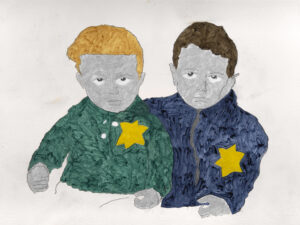
Lithuania is especially important in Jewish history and was home to important centers of Jewish learning. Kovno, as the capital city, was the largest city in the country. In 1939 Kovno had around 32,000 Jews living there
In June 1941 when Nazi Germany attacked its former ally the Soviet Union Lithuania also came under their control. In the immediate aftermath, not only the Germans but nationalistic Lithuanians started murdering the Jews. The regular German army, Wehrmacht, did not try to help the Jews when they saw Lithuanians murdering them.
Germans created a large ghetto in Kovno, Lithuania. In July 1941 they put around 35 000 Jews were into the ghetto.
Mass murder of thousands of Jews happened at various times in forts, which were fortifications the Russian empire had built. German special troops, Einsatzgruppen, whose task it was to murder the Jews, worked the locals.

During the first six weeks of the German occupation they murdered 10,000 Jews. Incidentally, a famous photo exists of a large group of Jews being led by Lithuanian forces to the seventh forth where they were murdered on July 27, 1941.
As we study this Torah portion, let us remember that even at that time, the Jewish Community was studying the Torah. Nazi Germany entered their countries and cities, and many lost their lives under the most brutal of circumstances.
Little did they know then that in a few years’ time the survivors could leave their exile. There would be a Jewish State. Decades later they would have Jerusalem, as prophesied.
*For an explanation of the terms see the first Pearls of The Torah Portion Blog.
| Coral and crystal cannot be mentioned, and the striving for wisdom [is more precious] than pearls. | רָאמ֣וֹת וְ֖גָבִישׁ לֹ֣א יִזָּכֵ֑ר וּמֶ֥שֶׁךְ חָ֜כְמָ֗ה מִפְּנִינִֽים: |
Job 28:18 (NKJV)
Again, the kingdom of heaven is like a merchant seeking beautiful pearls, who, when he had found one pearl of great price, went and sold all that he had and bought it.
Matthew 13:45-46 (NKJV)
Torah Scrolls were attacked and desecrated during the Holocaust. The enduring images of the Kristallnacht (November 9-10,1938) are those of synagogues on fire and Torah Scrolls burning. Some of these desecrated Torah Scrolls disappeared, others were buried. Some were lovingly rescued and are on display in museums in various locations.
[author] [author_image timthumb=’on’]https://irw.duv.temporary.site/website_047320a9/wp-content/uploads/2023/12/Dr-Sussanna-K-Round.png[/author_image] [author_info]Dr. Susanna Kokkonen received her Ph.D. in Holocaust Studies from the Hebrew University of Jerusalem. For ten years Dr. Kokkonen was the Director of the Christian Friends of Yad Vashem, World Holocaust Remembrance Center in Jerusalem. Dr. Kokkonen has authored several books about the Holocaust and antisemitism. She educates Christian audiences worldwide including about the Jewish roots of their faith. Dr. Kokkonen is the author of the exhibits for the Holocaust Garden of Hope and serves the Holocaust Remembrance Association as Educational Advisor. [/author_info] [/author]