December 10, 2025 – Dr. Susanna Kokkonen
December 2025 Blog
Pearl Harbor
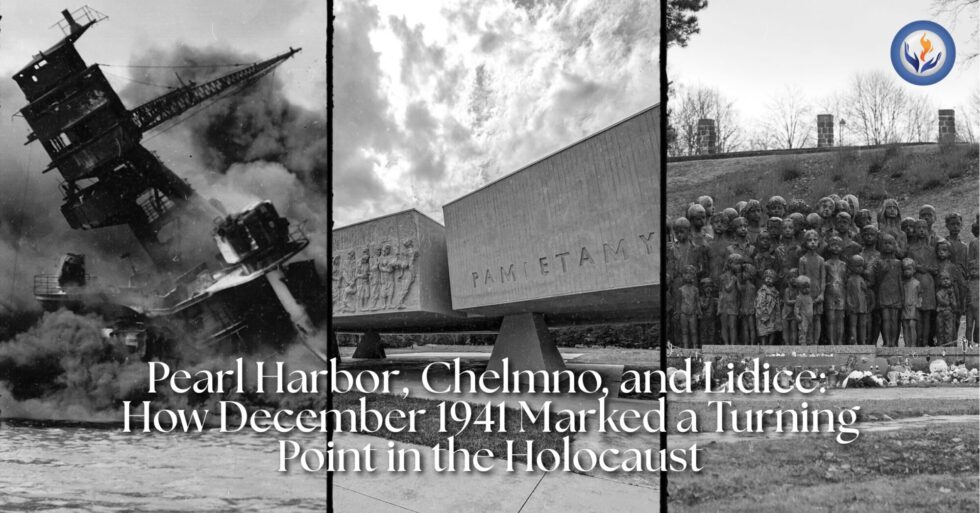
The month of December is an important one in the story of the Holocaust. December 7th, 1941, was when Japan executed its surprise attack on Pearl Harbor, Hawaii. Over 2400 Americans were killed at the naval base and nearby. President Franklin D. Roosevelt spoke at the Congress calling this “the day that would go down in infamy.”
Thus Japan pulled the United States in World War Two. Japan declared war on the United States of America but also on the United Kingdom. That meant that very soon after Japan’s allies Germany and Italy declared war on the United States as well as the UK. The United States did the same. Japan started attacking British colonies in the Pacific. This all meant that war now became global.
This all is especially important because the Holocaust took place during World War Two.
Chelmno
Incidentally, only a day after the Japanese attack, the death camp (killing center) of Chelmno was opened in Poland. This camp was the first one to use poison gas for murder and it operated until April 1943; and again from July 1944 until January 1945. There the Nazis murdered 152,000 Jews, app. 4300 Roma and some Polish nationals and Soviet prisoners of war. It is thought that only seven Jewish men escaped the camp.
The fate of the children from the town of Lidice is connected to Chelmno.
Lidice
Lidice could be an unknown small town near Prague in the Czech Republic. But the town became incredibly famous.
Reinhard Heydrich was a powerful Nazi leader and a ruthless figure even known as the “Hangman of Europe” and the “Blond Beast.” Heydrich became the Governor of Czech called the Reich Protector in the Protectorate of Bohemia and Moravia in 1942. On May 27, 1942, Czech resistance attacked him. This was a joint operation with the British who had trained the resistance fighters. Some locals did not support it, and the men were eventually betrayed. However, despite the difficulties, they managed to attack.
As Heydrich was taken to a hospital to clean his wounds, he died of an infection following his injuries on June 4, 1942. The resistance fighters all died too. They fought the Nazis who discovered their hiding place. Their families were sent to be murdered at the extermination camp of Mauthausen.
Nazi leadership demanded revenge.
As an act of revenge the Nazis now attacked the small town of Lidice. They destroyed the town, making it look like it had never existed. This was based on an unsubstantiated claim that some of the people connected with the Heydrich attack came from the town of Lidice.
On June 9-10, the Nazis attacked Lidice, murdering 173 men over the age of fifteen immediately. They shot some women too. Most women and girls over the age of sixteen were deported to the Ravensbrück camp; fifty-three of them died in concentration camps. Later, the Nazis attacked more places resulting in thousands of Czech deaths.
But what about the Lidice children?
Children from Lidice were sent to Lodz in Poland, a German-governed city. There the Nazis inspected them racially. Nine children who were judged to have Aryan (Germanic) appearance were selected for Lebensborn program, a program to produce more racially pure German children. These Czech children were sent to learn German, given German names and handed over to German parents. This same process happened in another town called Leźăky.
Other eight children, babies, were sent to a German orphanage in Prague. Following the massacre, there were still seven more children born to women from Lidice, to be placed in orphanages. Only eight of these noticeably young ones survived the war.
But there were eighty children who did not fulfill racial requirements. They were selected for murder. They were murdered in Chelmno extermination camp, established in December 1941.
After the War
Although the Nazis had tried to destroy the town of Lidice, they succeeded in making an unknown place known. In memories and history Lidice is connected to terrible Nazi violence.
The man who had ordered and led the attack was tried by a Czech people’s court in 1946. Karl Herman Frank was a Czech citizen of a German origin, living in the Sudeten area of Czech before the war. He decided to join the Germans, and this is what he became. He was executed. Several Lidice women attended his execution.
Some of the children who had been taken to Germany even testified at Nuremberg Trials.
We can certainly not imagine the horror of Lidice survivors, women, and children when they returned after the war. There was nothing where they had once lived. But they were brave. The town was rebuilt as a memorial to so many lives that were lost.
The Holocaust Remembrance Association exists to remember, reconcile, and take a stand against antisemitism in all its forms.
[author] [author_image timthumb='on']https://irw.duv.temporary.site/website_047320a9/wp-content/uploads/2023/12/Dr-Sussanna-K-Round.png[/author_image] [author_info]Dr. Susanna Kokkonen received her Ph.D. in Holocaust Studies from the Hebrew University of Jerusalem. For ten years Dr. Kokkonen was the Director of the Christian Friends of Yad Vashem, World Holocaust Remembrance Center in Jerusalem. Dr. Kokkonen has authored several books about the Holocaust and antisemitism. She educates Christian audiences worldwide including about the Jewish roots of their faith. Dr. Kokkonen is the author of the exhibits for the Holocaust Garden of Hope and serves the Holocaust Remembrance Association as Educational Advisor. [/author_info] [/author]