
November 28, 2025 – Dr. Susanna Kokkonen
This month I visited the Holocaust Garden of Hope for the very first time in Houston, Texas.
The location by lake is beautiful. We could hear birds singing and see the graceful pelicans.
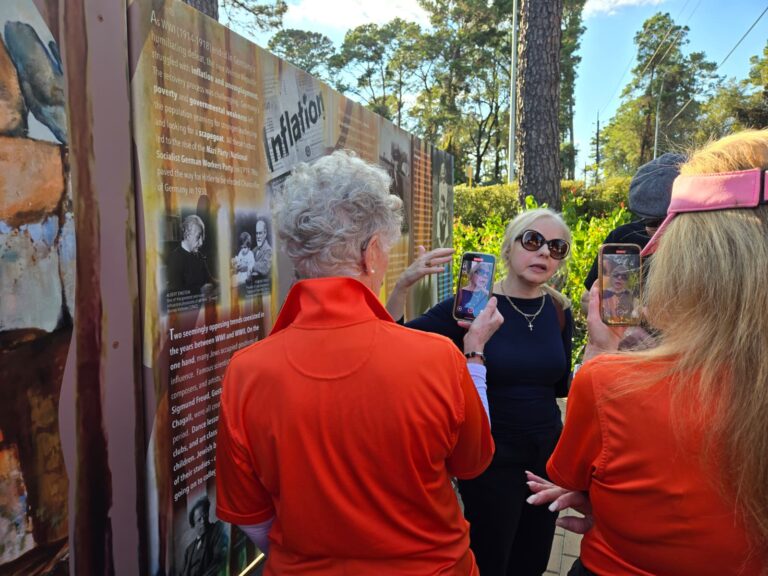
In the garden itself, I saw for the first time the exhibits we already have there. These in themselves offer the visitor a lot to see and read. This would be a perfect place to come with a group of young people to spend an afternoon or with friends and then go to a nearby cafe. You could enjoy the scenery. On a normal day it is possible to book a guided tour and on Sundays you can just come by in the afternoon, and somebody will be meeting you there.
What would the visitor take home from here?
First, the importance of remembering. On the very first panel we have the Hebrew root letters zayin, kaph and resh. This root zakar makes up all kinds of words that stand for remembering (to remember, remembrance) and more. The deeper meaning of these letters is to remember with the intent to act. The emphasis is on the fact that it is important to remember and talk about what we know, and if possible to act too.
Here we explain the basic facts of the Holocaust, but the main thing is the idea of humanity from the Bible and comparing creation (man was created in God’s image) to the Nazi idea of higher and lower races.
Second, we talk about Jewish life before the Holocaust. The Hebrew word here is tfutzah, which literally means distribution but really corresponds to the Greek word diaspora. We talk about Jews becoming part of European Society and creating the European culture that finally betrayed them. The life of the Jewish community in Germany especially changed from one day to the next. Even as society accepted them, antisemitism was growing too. They became artists, authors, scientists, and politicians. But then society betrayed them and they became hated by all.
Many changes took place in society. Exhibit three in Hebrew is called sheker meaning a lie. It is about propaganda and deception. It may look like the changes started suddenly, but there still had to be something underneath to make the change possible.
We understand that from the moment Adolf Hitler came to power, Germany started changing quickly, but in stages. The 1930s were a period when people could still have acted. From January 1933, every month witnessed some kind of change. Nazis changed laws. They burnt books. People rioted against the Jews with whom they had been living for so long in their cities. Suddenly society wanted to get rid of people who had disabilities or sicknesses. They did not want Jews among them.
The Night of the Broken Glass, Kristallnacht, was the first stage of failure.
It was the place of no return when things had gone too far. The only question that remained was what the world would be doing? Would they take in the Jews, or would they betray them too?
How touching it is to see that Great Britain received children who needed safety. There was Nicholas Winton, a young man rescuing 669 children. There was the Kindertransport program. One of the most beautiful and endearing images of Exhibit 3 is Paddington Bear. Michael Pond so the children arriving as refugees at Paddington Station in London and created his famous bear to look just like them.
Now each bear sold has a little note, just like the children around their necks, asking people to treat it well.
The garden tells the story of children and youth during the Holocaust. It is full of little interesting things for everyone but also for school children to see. A little girl icon will show you where there might be such a story. For instance, because so many know Anne Frank, her story is told on several exhibits chronologically.
Holocaust is a universal theme. There are so many ways to study it. But one of the most powerful for sure, is hearing the stories by the Holocaust survivors themselves. We tell those stories in the Holocaust Garden of Hope. The survivor testimonies are an invitation to join a journey.
To learn, to discover. To remember, to speak and finally to act.
The Holocaust Remembrance Association exists to remember, reconcile, and take a stand against antisemitism in all its forms.
[author] [author_image timthumb='on']https://holocaustremembranceassociation.org/wp-content/uploads/2023/12/Dr-Sussanna-K-Round.png[/author_image] [author_info]Dr. Susanna Kokkonen received her Ph.D. in Holocaust Studies from the Hebrew University of Jerusalem. For ten years Dr. Kokkonen was the Director of the Christian Friends of Yad Vashem, World Holocaust Remembrance Center in Jerusalem. Dr. Kokkonen has authored several books about the Holocaust and antisemitism. She educates Christian audiences worldwide including about the Jewish roots of their faith. Dr. Kokkonen is the author of the exhibits for the Holocaust Garden of Hope and serves the Holocaust Remembrance Association as Educational Advisor. [/author_info] [/author]