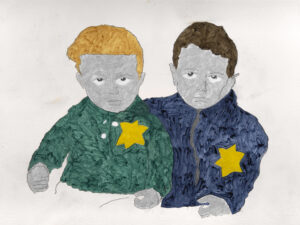

After a week’s delay due to bad weather, community members gathered on Sunday, Feb. 1, for a March of Remembrance. The public event honored Holocaust victims and survivors, empowering communities to confront hatred with truth, remembrance and moral courage.
The rescheduling did not diminish the spirits of those walking 1.8 miles from the Kingwood Community Center to the Holocaust Garden of Hope. Escorted by police and supported by other members of the community, those marching held signs such as, “I will not be silent” and “Remember reconciling.”
Organized by the Holocaust Remembrance Association (HRA18), the March of Remembrance has taken place annually in Houston, Kingwood and surrounding areas since 2012. HRA18’s core value is to create upstanders, individuals who will stand against antisemitism, as well as bigotry, prejudice and persecution in all forms.
HRA18’s focus on Holocaust survivor stories, along with stories of rescuers and repentant descendants of Nazi perpetrators, helps educate present and future generations.
The main event at the Kingwood Community Center opened with a vocal performance from opera singer Chris Holloway.
Rozalie Jerome, founder and president of HRA18, set the tone with her remarks, followed by remarks from Texas state Rep. Charles Cunningham (Dist. 127). Cunningham read a proclamation from County Commissioner Tom Ramsey, recognizing the Holocaust Remembrance Association for its 15th annual march.
“What unfolded at our 15th year of March of Remembrance Houston was deeply moving,” Jerome told the JHV. “Despite a last-minute weather postponement, an estimated 200 people still filled the Kingwood Community Center and chose to walk the 1.8 miles together to the Holocaust Garden of Hope.
“From young children to senior citizens, the crowd reflected a true cross-section of our community. We were honored to walk alongside Holocaust survivors and descendants of survivors, Nazi descendants, rabbis, Christian pastors and ministers and the German and Hungarian consuls, education and political leaders – all escorted by the Houston Police Department. It was a rare and powerful sight – people with very different histories choosing to walk shoulder to shoulder in public remembrance.”
 |
| JHV: VINCENT KHAN Holocaust survivor Michael Spiegel |
Holocaust survivor Michael Spiegel’s story of survival visibly moved the audience.
Born in Paris in 1937, Spiegel recounted his harrowing experiences of hiding during World War II in Vichy, France, before eventually moving to the United States in 1946.
Now 89, Spiegel shared vivid memories from ages 3 to 8, including a striking recollection of witnessing a parachute land nearby and the trauma of seeing a bloody body when he was just 6.
“One of my earliest memories is being 3 years old, screaming and crying as a woman put me into a trunk,” Spiegel said. “That woman was my mother and that was the last time I ever saw her.
“The Catholic priest at my school was aware of my Jewish identity and kindly agreed to hide me. I would go to school in a hurry and leave school in twice of a hurry out of fear that someone might snatch me away at any moment.”
Spiegel often shares his story in front of audiences, determined to keep the memory of the Holocaust alive. He inspired the audience by expressing his pride in being Jewish, encouraging everyone to take pride in their own heritage.
Despite the ongoing antisemitism in the world today, he urged everyone to remain proud of their Jewish roots.
“When I go to the Holocaust museum, they have the first, second and third descendants of Holocaust victims,” he said. “We bring them in so that they can carry the story. It’s not only the Holocaust survivors themselves, but their children, grandchildren and great-grandchildren [who keep the memory alive].”
“We pass the story down and that’s important. A hundred years from now, there will still be someone there to tell the story. People shouldn’t forget the atrocities that happened during the Second World War. You just don’t want to repeat it.”
The Walk of Remembrance served as a collective act of responsibility. Through the act of walking together, the community demonstrated a peaceful way to fight against antisemitism.
As survivors like Spiegel continue to share their stories, the responsibility to remember rests with future generations. The march reminded the community that remembrance is not passive; it is an ongoing promise to speak out, educate and stand as upstanders against injustice.
“This March felt especially significant given the rise in antisemitism and hostility toward Jews worldwide and Israel,” Jerome said. “It was not simply a commemoration of the past, but a visible moral statement in the present: that silence is not an option.
“By walking together, we demonstrated that remembrance must lead to responsibility, reconciliation and action. The community showed that even when circumstances are difficult, the commitment to stand against hatred and to honor history remains strong.”