
December 14, 2025 – Dr. Susanna Kokkonen
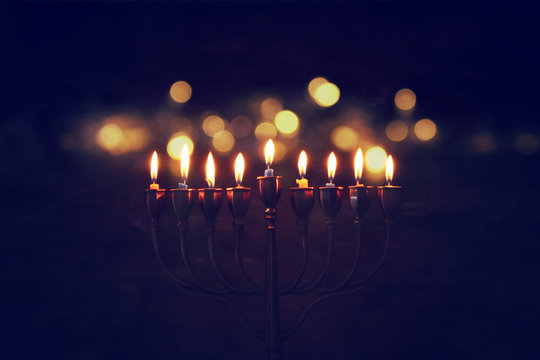
Two elements are mostly connected to Hanukkah: Light and Oil.
Light was the first thing God created. He then went on to separate elements that did not belong together. This separation is very symbolic because the story of Hanukkah is also fundamentally about separation. At the time when the Jewish warriors, the Maccabees were fighting against the Seleucid rulers and vastly outnumbered by their forces, there were those who wanted to assimilate. They would have allowed the Hebrew culture to be replaced by widespread Greek customs.
For a decade the Maccabees fought. They came up to Jerusalem, victorious, to a desecrated temple. And then? There was enough oil. For the menorah. That was a miracle. At the Temple, the menorah was set in such a way that the light was seen from outside. This is the meaning of light and Hanukkah. This is how it is celebrated today.
So what about celebrating Hanukkah in the darkest of places? Talmud makes provision for times of danger. It is permissible not to show the light to the outside.
Ghettoes
Surely that place was Lodz ghetto. There were many other places too, ghettoes and concentration camps. Hanukkah was celebrated.
In December 1943 in the ghetto of Lodz, Poland, Jews were celebrating Hanukkah. We have testimonies from these same people. Diaries are a valuable source of information and were smuggled out of ghettoes.
Oscar Singer was a German Jew; he had been deported to Lodz ghetto. He wrote in his diary about the candle lighting:
“One of the people gets a special honor. Usually it’s the daughter of the house, and she sings the candle-lighting blessing…The candles shine brightly, and memories of past Hanukkah evenings float to the surface. Memories from youth, from student years, memories of years lived in joy and freedom, scenes and pictures connected in some way to the festival of the Maccabees…Children also celebrate Hanukkah. In the larger apartments, many people gather. Everyone brings a small, fitting gift: a toy of some kind, a slice of cake, a hair ribbon…”
But Singer continued: “The menorah candles go out. Darkness prevails once more. We go out into the street. Ghetto life starts again.”
Eight months later, in summer 1944, they were all deported to the Chelmno and Auschwitz extermination camps. Their candles went out.
In 1941, a 14-year-old girl Ruth Lieblich wrote about ghetto Hanukkah in her diary: “…there were no candles on Hanukkah but in our hearts burnt a fire of love and hope that this will never happen again…”
Post-Holocaust
If Hanukkah was celebrated before the Holocaust and even in the ghettoes and camps, what about after?
Hanukkah returned to children’s homes and Displaced Persons’ camps. Hanukkah is a joyous time for children, and its message was perhaps needed more than ever in the post-Holocaust world. So Hanukkah was celebrated at the end of 1945 – the victory.
What must the survivors have felt about the cost?
If the Maccabees came back to a desecrated temple, surely the catastrophe in Europe was a modern-day desecration and more.
But they never stopped celebrating.
Right now a news story has come out about Israeli hostages lighting Hanukkah candles at the tunnels in Gaza. The six young people were filmed by Hamas in 2023, so this was a Hamas set up. The Israelis were executed eight months later.
One of them is heard mentioning Hanukkah celebrations by Jews under the Nazis.
Jewish holidays are an uplifting and joyous experience. As we see the world’s darkness around us, we need to celebrate the Festival of Light!
Feast of Dedication
For Christians it is important to know that Jesus too celebrated Hanukkah. In fact, the festival is mentioned in the New Testament. (It is not in the Old Testament, as it falls in the period between them.)
“Then came the Festival of Dedication at Jerusalem. It was winter, and Jesus was in the temple courts walking in Solomon’s Colonnade.” (John 10: 22-23 NIV)
We wish everyone Chag Sameach! Happy Hanukkah!
The Holocaust Remembrance Association exists to remember, reconcile, and take a stand against antisemitism in all its forms.
[author] [author_image timthumb='on']https://holocaustremembranceassociation.org/wp-content/uploads/2023/12/Dr-Sussanna-K-Round.png[/author_image] [author_info]Dr. Susanna Kokkonen received her Ph.D. in Holocaust Studies from the Hebrew University of Jerusalem. For ten years Dr. Kokkonen was the Director of the Christian Friends of Yad Vashem, World Holocaust Remembrance Center in Jerusalem. Dr. Kokkonen has authored several books about the Holocaust and antisemitism. She educates Christian audiences worldwide including about the Jewish roots of their faith. Dr. Kokkonen is the author of the exhibits for the Holocaust Garden of Hope and serves the Holocaust Remembrance Association as Educational Advisor. [/author_info] [/author]