
Hostages Held in Gaza: 53; IDF Soldiers Lost: 866
Last night, in the early hours of June 13, Israel launched Operation Rising Lion, a major pre-emptive strike against Iran’s nuclear and military infrastructure and key personnel. While much of the impact is still difficult to assess, the IDF has released a graphic highlighting the success of their attack yesterday.
- Israel’s raids began just after 3 am, when sirens sounded across Israel and Defense Minister Israel Katz confirmed operations were underway.
- Approximately 200 Israeli fighter jets participated in six waves of attacks, targeting over 100 key sites across Iran.

- Targets fell under four main categories:
- Nuclear weapons development facilities
- Ballistic missile production and storage
- Iran’s aerial defense systems
- Senior figures in the military and those involved with nuclear development.
- [WOW!] The Times of Israel writes: Israel spent years preparing for the operation against Iran’s nuclear and missile programs that was launched early Friday morning, including building a drone base inside Iran and smuggling precision weapons systems and commandos into the country. The Mossad spy agency reveals footage showing its actions against Iranian air defenses and ballistic missile launchers in Iran this morning.
- According to an Israeli official, the Mossad built a secret explosive drone base in Iran for this morning’s operation. The drones were used to strike ballistic missile launchers at a base near Tehran, preventing Iran from firing projectiles at Israel as this morning’s strikes began. Additionally, vehicles carrying weapons systems were smuggled into Iran. These systems took out Iran’s air defenses and gave Israeli planes air supremacy and freedom of action over Iran. A third covert effort involved Mossad commandos deploying precision missiles near anti-aircraft sites in central Iran.
- These strikes appear to be imposing three effects on the Iranian military:
- Suppressing Iranian air defenses: Strikes that destroy components of Iran’s air defense systems will cause a temporary disruption to Iranian defenses that would enable Israeli 4th-generation, non-stealthy aircraft to operate in Iranian airspace with greater ease.
- Degrading Iranian retaliatory capabilities: These strikes may have destroyed some of Iran’s missiles, launchers, and missile stockpiles, which would limit Iran’s ability to immediately retaliate in a meaningful way
- Disrupting Iranian command-and-control
- [WOW!] Axios reports: As it became clear Israel was about to attack, the commanders of the Islamic Revolutionary Guard Corps’ air force convened in a bunker to coordinate the response. But Israel knew that emergency protocol, and the location of the bunker. They destroyed it, killing the overall commander and the heads of the drone and air defense forces. “The fact that there was nobody to give the order neutralized an immediate Iranian response,” an Israeli official said.
- Numerous nuclear enrichment sites were hit to disrupt progress toward an Iranian nuclear bomb.
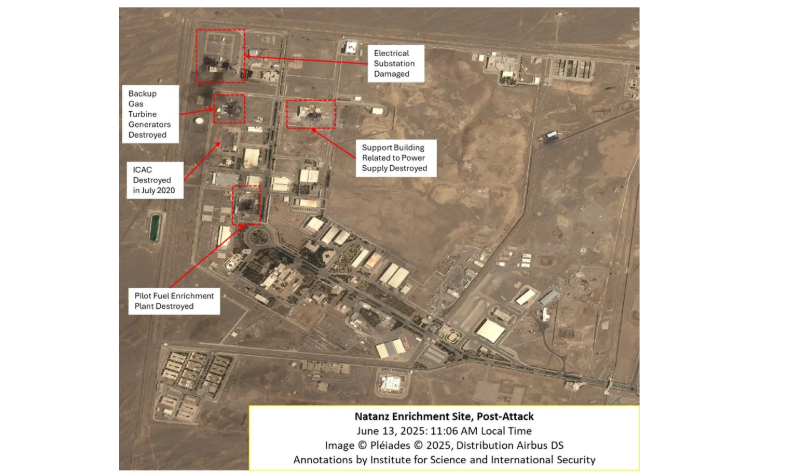
- Israel struck several facilities at the Natanz Enrichment Complex. The IDF says that a deep, underground site in Natanz, one of two important uranium enrichment facilities holding 52,000 centrifuges, has been destroyed.

- Satellite imagery also confirmed that the strike damaged electrical substations and support buildings critical to the power supply across the facility. As part of the strikes, the underground area of the site was damaged. This area contains a multi-story enrichment hall with centrifuges, electrical rooms, and additional supporting infrastructure.

Source: The Institute for Science and International Security - A senior Israeli official told Israeli media that Israel dealt a “severe blow” to Natanz but did not destroy it, and “there will be more strikes.”
- The IDF targeted prominent members of the Iranian nuclear research network. IDF Spokesman Brig. Gen. Effie Defrin reveals that the military has killed at least six top Iranian military commanders and nine nuclear scientists.


- Unspecified Iranian sources told a New York Times journalist that Israeli strikes killed IRGC Quds Force Commander Brigadier General Esmail Ghaani.

- Israeli Air Force fighter jets bombed two airbases in western Iran earlier today, the IDF announces. The strikes hit airbases used by Iran’s air force near the cities of Hamadan and Tabriz, the IDF says, adding that the latter site was “destroyed” in the strikes. Additionally, the IDF struck and dismantled dozens of targets belonging to the Iranian Regime’s Aerial Defense Array, UAVs, and surface-to-surface missile launchers.

Why Now?
- According to the Institue for the Study of War: The Israel Defense Forces declassified an Israeli intelligence report on June 12th that argued that Iran was approaching a “point of no return” in its ability to weaponize its nuclear program.
- The intelligence report, which cited the May 31 International Atomic Energy Agency comprehensive report, argued that Iran’s rapid enrichment of uranium would enable it to quickly weaponize and produce multiple nuclear weapons

- According to the IDF: The regime is producing thousands of kilograms of enriched uranium, alongside decentralized and fortified enrichment compounds, in underground, fortified sites. This program has accelerated significantly in recent months, bringing the regime significantly closer to obtaining a nuclear weapon.
- Eli Lake writes in The Free Press: The exact trigger for Operation Rising Lion may be recent intelligence Israel received that suggested Iran was going for a bomb. Prime Minister Netanyahu, in a statement after the initial strikes, asserted that Iran has taken “steps it has never taken before” to complete the last phase of constructing a bomb known as weaponization, or the design and construction of a warhead. The strikes also coincide with the Thursday release of a scathing assessment from the International Atomic Energy Agency that rebuked Iran for violating its commitments under the Nuclear Non-Proliferation Agreement, the treaty that prohibits all but five member states from using the power of the atom to build a nuclear weapon. It was the first such censure of Iran from the agency in 20 years.
Prime Minister Benjamin Netanyahu addressed the people of Iran directly earlier this evening:
- As we achieve our objective we are also clearing the path for you to achieve your freedom.
- The regime does not know what hit them, or what will hit them. It has never been weaker. This is your opportunity to stand up and let your voices be heard.
- As I said yesterday and many times before, Israel’s fight is not against the Iranian people. Our fight is against the murderous Islamic regime that oppresses and impoverishes you.
- The time has come for the Iranian people to unite around its flag and its historic legacy, by standing up for your freedom from the evil and oppressive regime.
Iran’s Response

Air raid sirens wailed across Israel on Saturday morning as Iran launched its fifth salvo of ballistic missiles, prompting nationwide alarm. The IDF said that it intercepted most incoming threats.
- According to the Times of Israel: Over 70 people were reported hurt in the strikes, including a woman who was critically wounded and later succumbed to her wounds. According to Magen David Adom, another person was seriously hurt and several more were moderately wounded. The rest were lightly injured or suffered acute anxiety.

Brief Commentary
- Mike Doran: Israel’s campaign against Iran is another one for the history books. As in the opening of the Six-Day War—when Israel crippled three Arab air forces in a matter of hours—Israel has struck first, deep, and hard. It hit targets across Iran, a huge country, with precision and total surprise. The scale and reach of the operation are staggering. Whether it will deliver a similarly decisive outcome remains, of course, to be seen. The regime could strike back—or begin to unravel. Either way, the message is unmistakable. This was more than a military action. It was a demonstration of intelligence dominance and operational mastery — and total justice.
- Matti Friedman: Tonight, here in Jerusalem, we woke up to a siren that sounded the same but turned out to mean something completely different…Since the Islamic Revolution of 1979, the theocracy in Iran has made it its business to wage war against Israel, a country that is more than a thousand miles away, and which has never posed a threat to Iran….It’s a cliché to say that the Middle East is at a turning point. But sometimes it’s true, and today—Friday, June 13, 2025—is one of those times.
- Reuel Marc Gerecht and Ray Takeyh: With Israel’s attack on Iran’s nuclear program, ballistic-missile facilities and senior officers and scientists, the age of diplomatic nonproliferation is over. It had been on life-support since North Korea went nuclear in 2006. Negotiations with Tehran tried hard to keep alive the hope that a deeply ideological regime massively invested in developing atomic arms could be dissuaded by sanctions or the allure of commerce….Tehran may have a difficult time recovering from its losses. Jerusalem has exposed again a great fear: that Iran’s national security has been penetrated, if not neutralized, by the Israeli intelligence service, Mossad….It seems unlikely that President Trump—who probably didn’t authorize the Israeli raid but also didn’t stop it—will object to Jerusalem’s ensuring that Tehran can’t get even. Mossad and Western intelligence services will be obliged to double down on the Iranian target. Everything is about to get a lot harder and more expensive for Tehran.
- Haviv Rettig Gur: I cannot in good conscience let this day pass without giving him the credit. I’ve worried for 20 months, aloud and repeatedly, that Netanyahu might not have the courage to go all the way, that he did not grasp our nation’s strength and courage and capability, and our collective resolve to forever rid ourselves of the shadow of the ayatollahs. And he did. He understood. He had it in him. He made the right call in the end. I was wrong. And thank God for that. Well done, Bibi.
- Michael Eisenstadt: These events should be seen as the culmination of a thirty-year covert Israeli campaign to disrupt and delay Iran’s nuclear program. They also represent the opening salvo of a new phase that will seek synergies between covert and intermittent overt military action, with the overall goal of disrupting efforts to reconstitute the program in the months (perhaps years) to come.
- Holly Dagres: Regardless of whether Tehran launches a heavy-handed retaliation or not, it risks domestic unrest, especially if Israel continues its reported days-long operation. Authorities have already restricted internet usage and threatened legal action against celebratory social media users, suggesting a preemptive crackdown.
I wanted to end this special update with the English translation for the traditional prayer for the soldiers of the Israel Defense Forces:
- He Who blessed our forefathers Abraham, Isaac and Jacob — may He bless the fighters of the Israel Defense Forces, who stand guard over our land and the cities of our God, from the border of the Lebanon to the desert of Egypt, and from the Great Sea unto the approach of the Aravah, on the land, in the air, and on the sea.
- May the Almighty cause the enemies who rise up against us to be struck down before them. May the Holy One, Blessed is He, preserve and rescue our fighters from every trouble and distress and from every plague and illness, and may He send blessing and success in their every endeavor.
- May He lead our enemies under our soldiers’ sway and may He grant them salvation and crown them with victory. And may there be fulfilled for them the verse: For it is the Lord your G-d, Who goes with you to battle your enemies for you to save you.